Our latest content
Check out what's new in our company !
When I first started working in power factor correction, I thought I had the easiest job in the world.
I was a surveyor, walking into factories, warehouses, and commercial sites with a proposition built on solid maths and physics. No behavioural change. No operational risk. No speculative claims. Just a line on the electricity bill that didn’t need to be there, and a proven way of removing it.
It felt obvious.
“You’re paying hundreds of pounds a month in avoidable charges. We can remove them.”
I assumed agreement would naturally lead to action.
“Where do I sign?”
It didn’t..
The part everyone already understood
To be fair, the technology itself was rarely the sticking point. Once explained, most sites accepted the logic quickly. Reactive charges existed. Power factor correction removed them. The equipment was mature, predictable, and largely invisible once installed.
Engineers were comfortable. Energy managers understood the numbers. Even finance teams rarely disputed the savings.
And yet, projects stalled.
Weeks became months. Decisions were deferred. Eventually, many organisations chose to continue paying the charge indefinitely rather than approve the project designed to remove it. They were also willing to turn a blind eye to the historic charges to maintain the status quo.
At first, this seemed illogical. Over time, it became clear that it wasn’t.
How boards actually decide
The real lesson wasn’t technical. It was commercial.
Capital expenditure is not simply money set aside for “good ideas.” It is reserved for assets that boards can see, justify, and explain. Production lines assemble. Vehicles deliver. New plant increases capacity or reduces risk. These projects have a physical presence and an operational story.
Power factor correction doesn’t.
Once installed, nothing visible happens. The site looks the same. Output is unchanged. The only evidence of success is the absence of a charge on an electricity bill. Carbon reductions, capacity savings, and reduced maintenance pretty much go on under the hood.
From a governance perspective, that absence is hard to champion.
Why saving money struggles to compete
There is also a subtle distinction that matters at board level: saving money does not behave like making money.
Revenue-generating assets feel active. They are perceived to “earn” in real time. Power factor correction quietly stops money leaking away, money that, crucially, was already being paid and already absorbed into operating costs.
Add a typical payback period of around two years, and the project begins to look even less compelling when set alongside capital investments with faster or more visible returns.
None of this reflects poor decision-making. It reflects how capital frameworks are designed.
The unavoidable conclusion
Once this was understood, the conclusion followed naturally.
If the barrier was capital, not confidence, not technology, then insisting on capital funding was the problem.
After all, the charges being removed were already being paid, month after month, to the energy supplier. They were real cash costs, already affecting the bottom line.
So the question became less provocative over time, and more obvious:
Why should a project whose sole purpose is to remove an ongoing charge require new capital at all?
Following the logic to its natural end
Seen through that lens, the solution was straightforward and, in hindsight, inevitable.
If the cost already exists, and the solution simply removes it, then the most natural funding source is the cost itself. Redirect the value of the reactive charges into the installation, and two long-standing objections disappear at once.
There is no upfront capital decision competing with other priorities.
And there is no ongoing drag on operating costs once the system is in place.
The project stops being a capital request and becomes a reallocation of an existing inefficiency.
How this is now handled in practice
This way of structuring power factor correction is no longer theoretical. It is how projects are now routinely delivered in many cases.
The engineering does not change. The same equipment is specified. The same installers and electrical contractors carry out the work. The same performance outcomes are expected and achieved.
What changes is the commercial pathway.
As reactive charges disappear from the bill, the equivalent value is used to fund the installation. From the organisation’s point of view, capital remains untouched, and the bottom line improves without taking on a new recurring cost.
The stalemate finally disappears
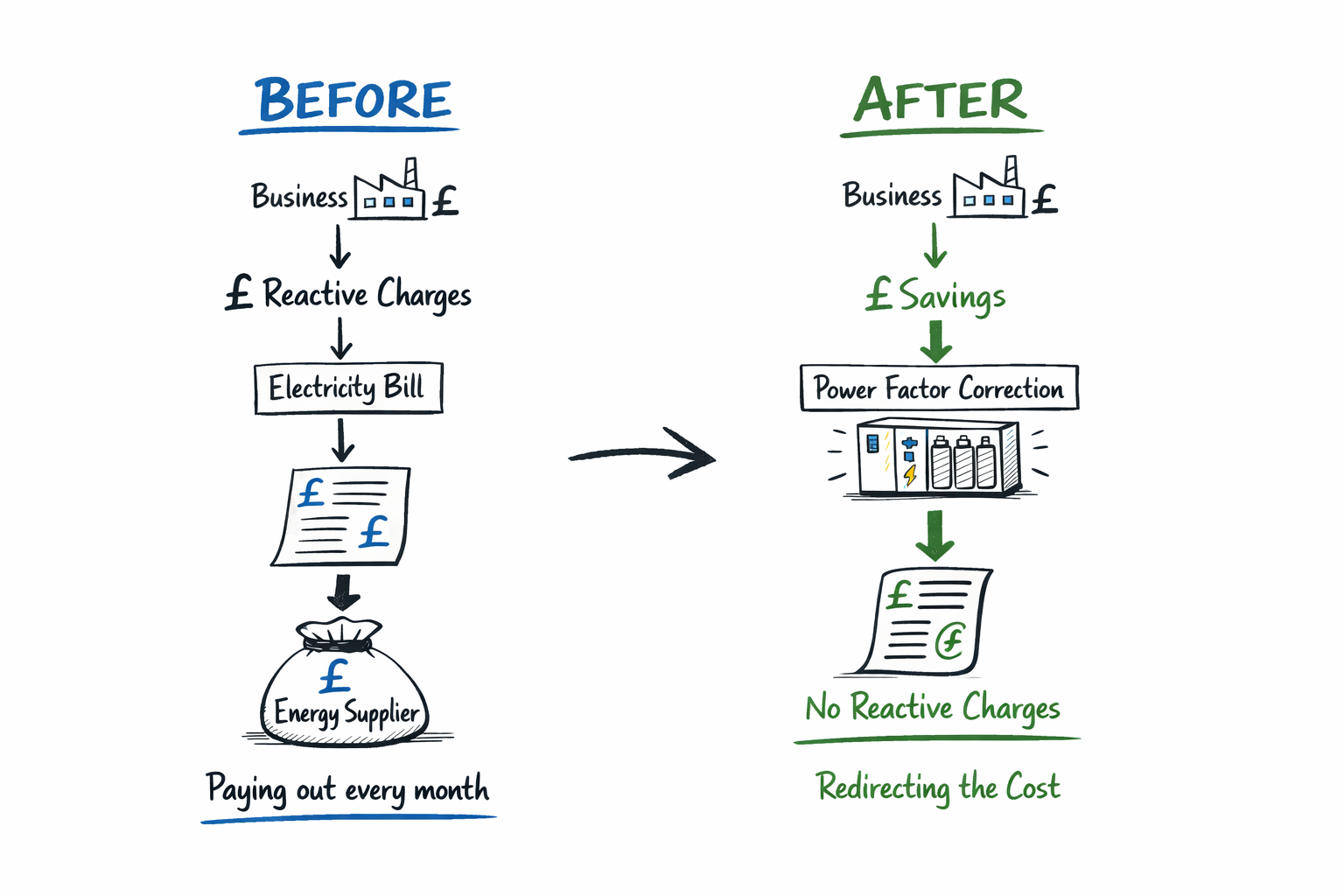
Once framed this way, the long-standing tension around power factor correction largely evaporates.
- Engineers see a technically sound solution delivered as intended.
- Finance teams avoid capital pressure.
- Boards see an inefficiency removed without compromising other priorities.
Nothing about the technology has been exaggerated. Nothing new has been introduced. The project simply aligns with how financial decisions are actually made.
Closing the loop
Looking back, my early instinct wasn’t wrong, it was just incomplete.
Power factor correction really is a solved engineering problem. What took longer to recognise was that it required a commercial structure that matched its nature.
By funding the solution from the savings it creates, power factor correction finally stops asking boards to choose between doing the right thing and protecting capital. It does both, quietly, predictably, and in a way that now feels entirely standard.