How Wasted Costs Can Fund Their Own Solution
Introduction: The Fallacy of Waiting
When budgets are tight, the instinct to delay new expenses feels prudent. It seems like the safest way to conserve capital. But what if this "wait and see" approach isn't just postponing a solution? What if it’s actively the most expensive decision your business can make?
1. The Most Expensive Decision is Often to 'Do Nothing'
The cost of inaction is a measurable financial leakage that quietly undermines profitability. It’s the continuous drain caused by choosing not to solve a problem that carries a recurring expense. Instead of preserving capital, this choice actively depletes it over time.
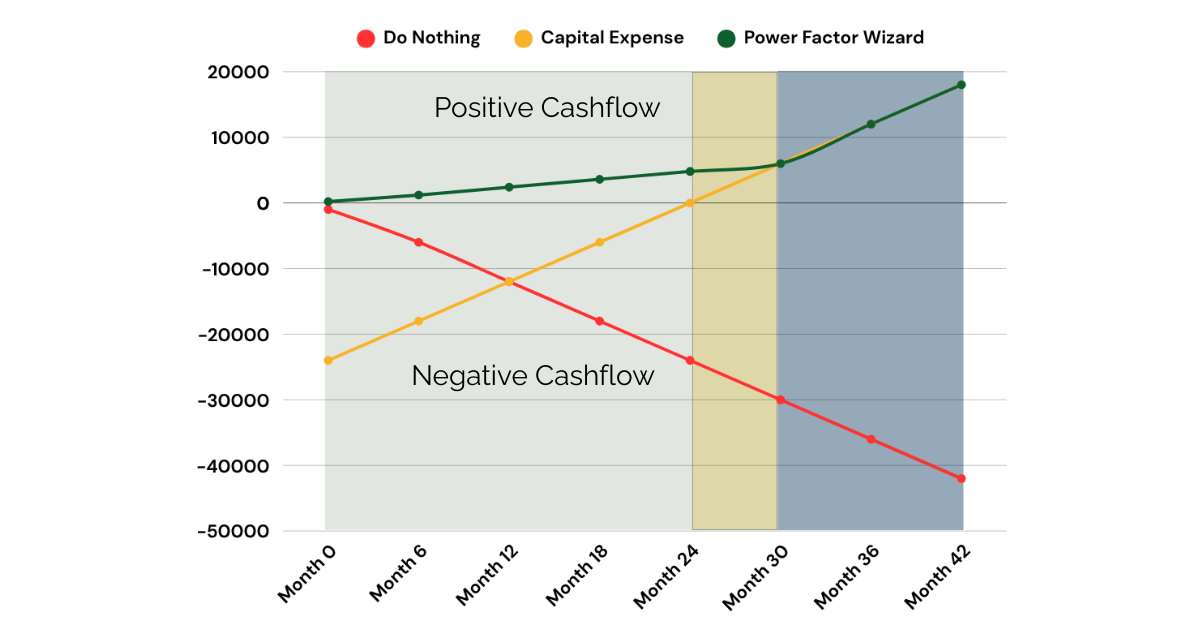
In the illustrated model, the "Do Nothing" scenario (the red line) involves paying a £1,000 monthly reactive energy charge indefinitely. This path results in a cumulative loss of over £40,000 in under four years. The critical insight here is that inaction isn't a neutral choice; it's a financial decision with severe consequences. Typically, there are two paths to fixing such a problem: a direct capital expense or an alternative funding model that avoids upfront costs.
2. You Can Pay for a Solution With Money You're Already Wasting
The most common barrier to fixing operational issues is the upfront capital required. The standard approach is a direct capital expense, investing cash to solve the problem immediately. As the model's yellow line shows, this requires a significant initial outlay of £24,000. While effective, it ties up valuable capital.
An innovative alternative eliminates this primary barrier. The "Power Factor Wizard Funding" model allows a business to fix the root cause of the charges with no initial capital outlay. The mechanism is straightforward: the savings generated by the solution are used to make the payments on the solution itself. The cash that would have been wasted on reactive charges is instead diverted to cover the project cost.
This approach is built on a clear and powerful logic:
act sooner, save sooner, and let the savings fund the fix.
By removing the upfront cost, this model empowers businesses to take corrective action without impacting their capital reserves.
3. The Payback is Faster Than You Think
A clear return on investment (ROI) is essential for any project. In this model, the £24,000 installation eliminates the £1,000 monthly reactive charge, creating a clear payback period of just 24 months for the capital expense option.
However, the funding model offers an even more compelling financial case. While the capital expense route breaks even at Month 24, the "Power Factor Wizard" option (the green line) achieves positive cash flow immediately from Month 1. By Month 42, it results in the highest cumulative savings of all three scenarios. After the project is paid off, the eliminated £1,000 monthly charge becomes a direct and permanent contribution to your bottom line.
Conclusion: What Is Inaction Costing You?
While delaying spending can feel like a sound financial strategy, the real cost often lies in the recurring problems we choose not to solve. The money lost to inefficiency can, in many cases, fully fund the very solution needed to eliminate it. What 'do nothing' decisions are quietly costing your business every month?